
Frequently Asked Questions
FAQs
FAQs
Frequently Asked Questions
What is a Urea Breath Test?
The Urea Breath Test (UBT) is a quick, non-invasive diagnostic test used to detect an active infection of Helicobacter pylori (H. pylori)—a common bacterium responsible for stomach ulcers, chronic gastritis, and digestive discomfort.
Because it measures live bacterial activity rather than past antibodies, it is considered the gold standard for both diagnosing H. pylori and confirming that the bacteria have been successfully eliminated after treatment.
How It Works (Mechanism)
The test takes advantage of a unique feature of H. pylori: the bacteria produce an enzyme called urease, which is not naturally present in the human stomach.
Ingestion: You swallow a Headway ¹³C-Urea capsule (75mg) with water. Carbon-13 is a naturally occurring, completely non-radioactive and harmless isotope of carbon.
Breakdown by Bacteria: If H. pylori is present in your stomach, its urease enzyme rapidly breaks down the 75mg ¹³C-urea capsule into ammonia (NH₃) and labeled carbon dioxide (¹³CO₂):
(NH₂)₂CO (Urea) + H₂O →[urease] 2NH₃ + ¹³CO₂
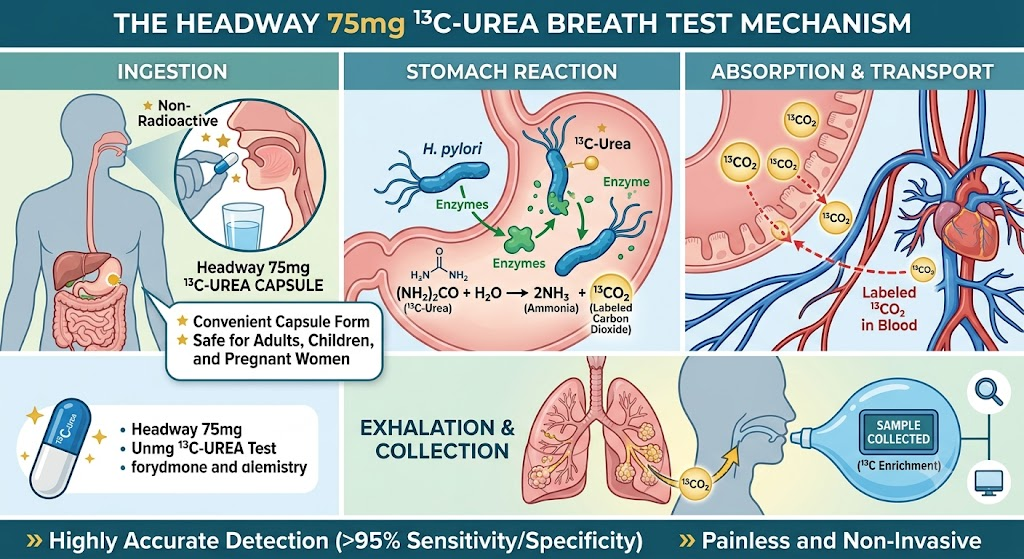
Absorption & Exhalation: The ¹³C-carbon dioxide enters your bloodstream, travels to your lungs, and is exhaled in your breath.
Analysis: You blow into a collection breath bag 20 to 30 minutes later. A laboratory uses infrared spectroscopy or mass spectrometry to measure the amount of ¹³C in your exhaled breath.
- Higher ¹³C levels = Positive for active H. pylori.
- Normal ¹³C levels = Negative for H. pylori.
Why Choose the Headway 75mg ¹³C Capsule Test?
- Convenient Capsule Form: The Headway 75mg capsule is easy to swallow, avoiding the need for bulk liquid solutions.
- Safe for Everyone: Because Carbon-13 is non-radioactive, the test is safe for children, pregnant women, and nursing mothers.
- Highly Accurate: Delivers over 95% sensitivity and specificity.
- Painless & Fast: Requires no needles, sedatives, or invasive procedures—just swallowing a capsule and breathing into a collection device.